Tuesday, November 19, 2013

NAHB's Housing Market Index flat, but remains positive despite political uncertainty, construction costs - The Business Journals

NAHB's Housing Market Index flat, but remains positive despite political uncertainty, construction costs - The Business Journals


Washington Bureau Chief
Email  | Twitter  | Google
Home builders remain kind of confident in the market for new single-family homes, despite policy uncertainties in Washington, D.C., and rising construction costs.
The Housing Market Index compiled by the National Association of Home Builders remained at 54 in November. This marked the sixth consecutive month that more home builders viewed market conditions as good rather than poor.
That's "an encouraging sign, considering the unresolved debt and federal budget issues cause builders and consumers to remain on the sideline," said NAHB Chief Economist David Crowe.
The survey asked builders to rate current sales, sales expectations, and traffic of prospective buyers.
Current sales conditions stayed at 58, while expectations for future sales fell one point to 60. Buyer traffic was the index's worst-performing component, dropping one point to 42.
"Given the current interest rate and pricing environment, consumers continue to show interest in purchasing new homes, but are holding back because Congress keeps pushing critical decisions on budget, tax and government spending issues down the road," said NAHB Chairman Rick Judson, owner of Evergreen Development Group in Charlotte, N.C. "Meanwhile, builders continue to face challenges related to rising construction costs and low appraisals."

Friday, November 8, 2013

Carolina Realtors: October home sales up 10% year-over-year - Charlotte Business Journal

Carolina Realtors: October home sales up 10% year-over-year - Charlotte Business Journal


Staff Writer-Charlotte Business Journal
Email  | Twitter  | Google+


Closings for Charlotte-area homes increased by 10 percent in October compared to the same time in 2012, according to the Charlotte Regional Realtors Association’s monthly market activity report released today.
Realtors closed on 2,831 homes sales last month in the 10-county Charlotte region tracked by the association, up from 2,574 in October 2012, the report states.
Closings have slowed in recent months, as is typical for later in the year. Charlotte-area closings were 3,392 in August and3,527 in July. But October’s figures were slightly better than September’s, which recorded 2,825 closings.
“The pace of sales seems to be slowing, which is typical for this time of year,” saysEric Locher, CRRA president. “Our local housing recovery continues, though given the challenges of persistently low inventory, tight credit, rising interest rates and uncertainty on the federal level, future sales could be impacted.”
Sale prices also increased for the 23rd month in a row in October.
The average home sales price in October was $210,278, up 2.9 percent from $204,284 during October 2012. The median sales price — considered a more accurate measurement — rose 8.2 percent during the year to $169,900, up from $157,000.
Average list prices jumped 9.2 percent to $252,415 from $231,150 during the same time last year. The number of pending sales hiked 22 percent to 2,989 last month, up from 2,449 a year earlier.
New residential listings also grew, by 17 percent to 4,160 year-over-year.
The Charlotte region, as tracked by CarolinaMLS, now has a 5.3-month supply of homes for sale. Properties are remaining on the market an average of 96 days from listing to closing, a decline of 12 days compared to October 2012.
Foreclosures and short sales represented 8.1 percent of the market’s new listings and 8.8 percent of all closed sales in October, according to the report.
The CRRA, a trade association with more than 6,000 Realtor members, uses a vendor that compiles its monthly market report based on data from its Carolina Multiple Listing Services Inc.

Charlotte home sales rise 10% in October | CharlotteObserver.com

Charlotte home sales rise 10% in October | CharlotteObserver.com

Charlotte-area home sales rose 10 percent in October from a year ago as fewer properties were put up for sale, the Charlotte Regional Realtor Association reported Friday.
The average sales price was also up, rising 3 percent to $210,278, the report on existing-home sales showed. Compared with September, prices fell 5 percent.
In October, 2,831 homes sold, up less than 1 percent from September.
Inventory, which is being widely watched in Charlotte and elsewhere, dropped to a 5.3-month supply from 6.9 months’ worth a year ago. The tight supplies are credited with helping drive appreciation, as potential buyers try to outbid one another for some properties. In October, 15,366 homes were listed for sale in the Charlotte region, down 8 percent from a year ago and 1 percent from September.
It’s unclear how much of a drag rising mortgage rates and low supplies will be on the housing market, which traditionally slows down in the second half of the year. Eric Locher, president of the association, said in a statement that Charlotte’s housing market continues to recover. But, he said, “given the challenges of persistently low inventory, tight credit, rising interest rates and uncertainty on the federal level, future sales could be impacted.”
The association’s report comes after real estate data company CoreLogic said Tuesday that Charlotte-area home prices rose 7.1 percent in September from a year ago, for the 19th month in a row of year-over-year gains.

Read more here: http://www.charlotteobserver.com/2013/11/08/4449157/charlotte-home-sales-rise-10-in.html#.Un0kH3CX98E#storylink=cpy

Tuesday, November 5, 2013

Charlotte home prices rise 7.1% in September | CharlotteObserver.com

Charlotte home prices rise 7.1% in September | CharlotteObserver.com

Charlotte-area home prices rose 7.1 percent in September from a year ago, for the 19th month in a row of year-over-year gains, real estate data company CoreLogic said Tuesday.
Prices rose 12 percent across the U.S, which also has seen consecutive months of annual gains since March 2012.
But home prices in the Charlotte region fell 0.1 percent in from August, while they increased 0.2 percent nationwide.


Read more here: http://www.charlotteobserver.com/2013/11/05/4441322/charlotte-home-prices-rise-71.html#.UnksmnCX98E#storylink=cpy

Friday, November 1, 2013

U.S. Mortgage Rates at 4-Month Low Fall for Second Week - Bloomberg

U.S. Mortgage Rates at 4-Month Low Fall for Second Week - Bloomberg

U.S. mortgage rates dropped for a second week, keeping borrowing costs at a four-month low as the Federal Reserve signaled that it would press on with its stimulus plan aimed at holding rates down.
The average rate for a 30-year fixed mortgage fell to 4.1 percent the week ended today from 4.13 percent, Freddie Mac said in a statement. The average 15-year rate declined to 3.2 percent from 3.24 percent.
Mortgage rates have fallen from two-year high in August as weaker-than-expected economic data drives investors to the safety of government bonds that guide consumer debt. The Fed said yesterday it will continue with $85 billion in monthly bond purchases, saying it needs to see more evidence that the economy will continue to improve. Confidence among U.S. consumers declined in October by the most since August 2011 as the budget impasse and debt-ceiling negotiations in Washington took a toll on outlooks.
“For the next several months, we’re likely to see housing markets, at best, flat and maybe down a little bit while we are awaiting a pickup in the economy,” David Berson, chief economist for Nationwide Insurance in Columbus, Ohio, said in a telephone interview yesterday.
Contracts (USPHTMOM) to buy previously owned homes declined 5.6 percent in September, the most in more than three years, according to the National Association of Realtors.
Buyer competition for a limited supply of homes has been fueling price gains. The S&P/Case-Shiller 20-city index showed prices increased 12.8 percent in August from a year earlier.
A monthly measure of prices by the Federal Housing Finance Agency increased 0.3 percent increase in August from July, the smallest gain in 11 months, as more homeowners listed their properties for sale.

Sept. Case-Shiller Expected to Continue Showing Eye-Popping Annual Appreciation | Zillow Real Estate Research

Sept. Case-Shiller Expected to Continue Showing Eye-Popping Annual Appreciation | Zillow Real Estate Research

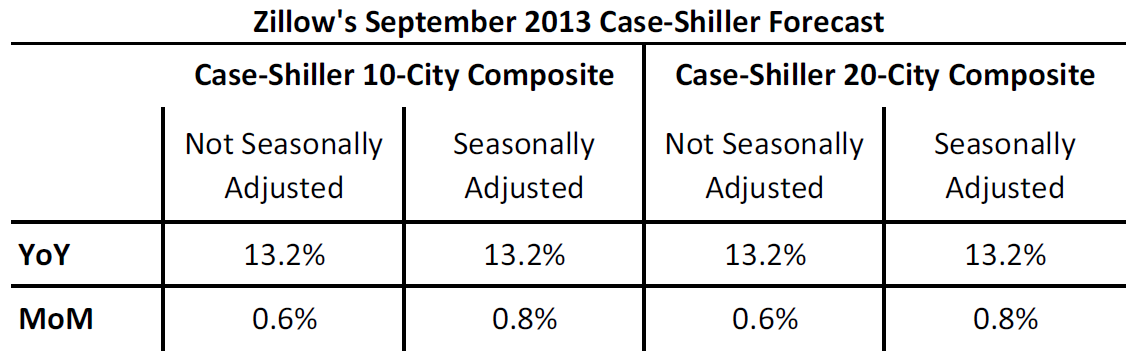
The Case-Shiller data for August came out this morning, and based on this information and the September 2013 Zillow Home Value Index (ZHVI, released Oct. 17), we predict that next month’s Case-Shiller data (September 2013) will show that both the non-seasonally adjusted (NSA) 20-City Composite Home Price Index and the NSA 10-City Composite Home Price Index increased 13.2 percent on a year-over-year basis. The seasonally adjusted (SA) month-over-month change from August to September will be 0.8 percent for both the 20-City Composite and the 10-City Composite Home Price Indices (SA). All forecasts are shown in the table below. Officially, the Case-Shiller Composite Home Price Indices for September will not be released until Tuesday, Nov. 26.
table
The Zillow Home Value index showed the first signs of moderation in home value appreciation, with several of the largest metros showing month-over-month declines in September. Case-Shiller indices have also shown slowdowns in monthly appreciation but have not yet recorded monthly declines. Even when the Case-Shiller indices do show monthly depreciation in some areas, they will continue to show an inflated picture of home prices, especially when considering year-over-year growth. The Case-Shiller indices are biased toward the large, coastal metros currently seeing enormous home value gains, and they include foreclosure resales. The inclusion of foreclosure resales disproportionately boosts the index when these properties sell again for much higher prices — not just because of market improvements, but also because the sales are no longer distressed.
In contrast, the ZHVI does not include foreclosure resales and shows home values for September 2013 up 6.4 percent from year-ago levels. More on the differences between a repeat sales index, including the Case-Shiller indices, and an imputed hedonic index like the ZHVI can be found here. We expect home value appreciation to continue to moderate through the end of 2013 and into 2014, rising 3.8 percent between September 2013 and September 2014 — a rate much more in line with historic appreciation rates. The main drivers of this moderation include rising mortgage rates, less investor participation – leading to decreased demand – and increasing for-sale inventory supply. Further details on our forecast of home values can be found here, and more on Zillow’s full September 2013 report can be found here.
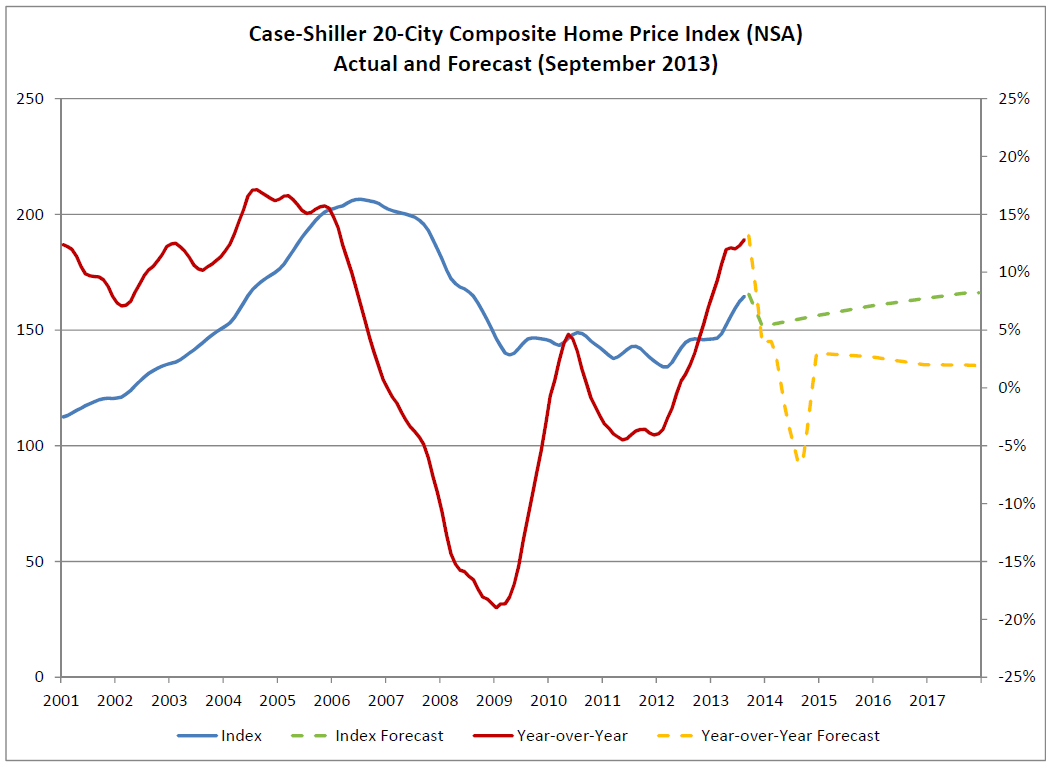
chartTo get some sense of where the Case-Shiller Composite-20 Index will go over the coming years, this chart combines: 1) the historical trajectory of the index; 2) next month’s forecast given above based on current Zillow data; and 3) Zillow’s forecast for real estate appreciation over the next five years, based on the Zillow Home Price Expectations Survey, which includes input from more than 100 economists. These panelists actually predict the five-year path of the ZHVI, not the Case-Shiller index, but the future expectations are interesting nonetheless when applied to the current Case-Shiller index levels. The latest Zillow Home Price Expectations Survey (2013 Q3) came out in early August, and the next one will be released in November.
To forecast the Case-Shiller indices, we use the August Case-Shiller index level, as well as the September Zillow Home Value Index (ZHVI), which is available more than a month in advance of the Case-Shiller index, paired with September foreclosure resale numbers, which Zillow also publishes more than a month prior to the release of the Case-Shiller index. Together, these data points enable us to reliably forecast the Case-Shiller 10-City and 20-City Composite indices.

Fed's caution on housing may be overblown - The Term Sheet: Fortune's deals blogTerm Sheet

Fed's caution on housing may be overblown - The Term Sheet: Fortune's deals blogTerm Sheet

FORTUNE -- The Federal Reserve on Wednesday pressed ahead with its stimulus program of asset purchases and low interest rates. Yup, as widely expected (and reported), the end of its two-day meeting was pretty much a snoozer: For the most part, the central bank made few changes to its description of the state of the economy, saying that it has "continued to expand at a moderate pace" and job markets "have shown further improvement."
What's interesting, however, is that policymakers slightly changed their views of the housing industry, acknowledging that the recovery has "slowed somewhat in recent months." It was only at its last meeting in September when the central bank said the housing industry was "strengthening."
Whatever the Fed's take, it would be short-sighted to read too much into it. After all, what the central bank chooses to say and not say is puzzling. Even though the government shutdown cost the U.S. economy billions of dollars, it made no direct mention that Uncle Sam was partially out of business for more than two weeks.
And yet, the Fed chose to bring up the state of the housing market. True it has modestly slowed down, but that's inconsequential because the recovery is nowhere near reversing. Home prices are rising more slowly now than in the spring, but they're still climbing fast, writes Jed Kolko, chief economist at real-estate website Trulia.
One main reason: Nationally, and in all of the 100 largest metro areas, it's still significantly cheaper to buy than rent, Kolko says. Mortgage rates have made buying more expensive; the 30-year fixed rate is now 4.8% compared with 3.75% a year ago. And as a result, the cost gap between buying vs. renting has narrowed. A year ago, it was 45% cheaper to buy than rent in the U.S. That has fallen to 35% today, but the cost incentive to buy is still substantial.
There are caveats, of course, where it's harder to justify the costs of buying over renting. Across several parts of California such as San Francisco, San Diego, and Los Angeles, buying isn't that much cheaper than renting, according to Trulia. However, buying is a bargain in places like West Palm Beach, Fla., as well as parts of Ohio and Michigan.
Meanwhile, U.S. home prices have continued to recover, which gives those on the fence about selling a reason to put their home on the market and help stabilize prices. In August, prices rose at their fastest annual pace since February 2006 -- the height of the housing bubble, according to the latest reading from the S&P/Case-Shiller Home Prices Indices. On average, prices are back to their mid-2004 levels, but still roughly 20% below their summer 2006 peak.
Both home prices and mortgage rates are rising from record lows. So whatever worries the Fed has about the economy, it likely has less to do with housing than uncertainty surrounding Washington.